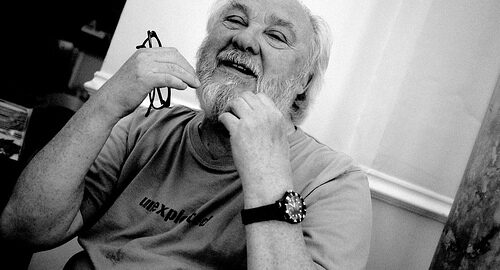

King Crimson's lyricist, Pete Sinfield produced Roxy Music's debut album in 1972 at Command Studios in London, then the single "Virginia Plain" a few months later. He looks back on tense, rushed sessions, on the explosions he made with a synthesizer, and on a Bryan Ferry who was still learning to be Bryan Ferry.
Lire cette interview en français
I interviewed Pete Sinfield in August 2006, in English. He was recovering from a serious operation and working on a second solo album, more than thirty years after Still, his only solo album, released in 1973. Our conversation was about another album: the one he produced in the spring of 1972 for a band nobody knew yet. His answers are given here as he spoke them, lightly edited for readability.
A founding member of King Crimson, whose lyrics he wrote from In the Court of the Crimson King in 1969 onwards, and who played the VCS3 synthesizer from the audience at the band's concerts, Pete Sinfield left the group at the end of 1971. His managers at EG Management then asked him to produce Roxy Music's first album, recorded in March 1972 at Command Studios in Piccadilly and released on 16 June that year. He went on to write for Emerson, Lake & Palmer, then pop hits for Bucks Fizz and Celine Dion. Pete Sinfield died on 14 November 2024, aged 80.
Laurent Rieppi: Could you tell us how you got involved in producing the first Roxy Music album?
Pete Sinfield: It was very simple. I was managed by some people called EG Management, who managed King Crimson and managed me. And after King Crimson split up, well, went into hiding for a bit, they were taking on new acts, and one of the people they were thinking of taking on was Roxy Music. They asked me to go and see them, and I said, they're extraordinary, they're very imaginative and brilliant. And they decided to sign them. They were not quite sure whether they should sign them. I was absolutely sure, but they were not quite sure. But they are management, you know, not artists. Because we were under the same roof, as it were, I went to some of their rehearsals and one thing led to another. And somebody said, why don't you produce the record? And so I said, I'd love to.
Laurent Rieppi: Where and when was the album recorded?
Pete Sinfield: It was recorded in a hurry, in the middle of 1972, in the summer. I know it was the summer. And it was in a studio called Command Studios, which is in Piccadilly. It was an interesting studio. It was an old BBC recording studio, and it had an original echo chamber with, you know, stone walls. A real old-fashioned echo chamber, which is why some of the echo on the album is really lovely, because it's not done with electronics or springs. It's done with real things. And it was done in this sort of old-fashioned studio, which had very good sound, lots of valves. One of the reasons the album sounds very organic is the actual nature of the old-fashioned studio it was done in.
Author's note: Sources date the recording of the album from 14 to 29 March 1972, with a release on 16 June 1972. "Virginia Plain" was recorded in July 1972.
Laurent Rieppi: What equipment did you use on this record? What multitrack recorder, for example?
Pete Sinfield: It must have been a 24-track. It would have been a… whatever they were called. What are they called? Ampex. An Ampex 24-track. And, very important, the UA compressors. They're called UA. They're sort of old valve compressors which, once again, like some of the stuff in the studio, were sort of old-fashioned, but gave it a very, very nice, almost American sound, perhaps. Not such an English sound. The desk, I can't tell you what the desk was. The engineer was very important. It was a man called Andy Hendriksen and, frankly, without him it would never have been made as well as it was, to the level it is. He gets overlooked. He never gets mentioned, so I thought I should mention him. A guy called Andy Hendriksen was the engineer, and he was magic.
Author's note: UA stands for Universal Audio, an American maker of studio equipment, including compressors. Andy Hendriksen is credited for engineering and mixing on the album.
Laurent Rieppi: How long did it take to record the album?
Pete Sinfield: Well, I think I read it took ten days. I think it must have been a bit longer than that. Maybe I had the band for ten days. I was in the rehearsals with them before, for maybe two or three weeks. They had a lot of material, and we picked… well, more or less, we recorded everything. I think it was about ten days, and maybe I was there for another five days mixing. It was all done very, very quickly. I remember working sixteen hours a day, long hours. It was difficult, because the band were very imaginative, but they were not the best musicians. Not bad musicians, but, you know, some things took a long time to get right. And everyone got a little bit tired, and it was very hot. And then we went back to record "Virginia Plain", because I heard Bryan playing it at a rehearsal after we'd finished the album. We went back for three days to record that.
Laurent Rieppi: Was it a big or a low budget album?
Pete Sinfield: No, it was low. Comparatively low. It was low really just because of the time, because they were starting to go on the road, people were interested in signing them, and the management very much wanted to get them in and out. I can't think what it cost, money in those days… probably about ten thousand pounds, but that was in 1972, so that's whatever that is in today's money. But I think you could say it was low budget, because there weren't extra session musicians really. Except we had to get a bass player, of course, because the bass player, [Graham Simpson], had a nervous breakdown halfway through the record, which didn't make it any easier, and we had to get the bass re-recorded in some circumstances. But it wasn't a big budget.
Author's note: Sources usually put the cost at £5,000 in studio fees, paid by EG Management, as the band had no record deal yet at the time of the sessions. Graham Simpson, credited on bass on the album, later left Roxy Music; Rik Kenton plays bass on "Virginia Plain".
Laurent Rieppi: Do you have a special memory of recording "Re-Make/Re-Model"?
Pete Sinfield: That's the one with all the breaks in, isn't it? That's the one where there's bits of Duane Eddy guitar… I wanted them to quote all sorts of different periods of rock and roll, and I wanted to show off the humour of the band. So that's got the sax going, that's got that "Re-make/Re-model" bit in it. And I think we had a laugh deciding which little bits of music, the Duane Eddy guitar or which things we would try, for fun really. And that was one of the better moments, because a lot of it is quite doomy, and it was tricky to record. There was a lot of tension on some of the synthesizer bits. Unfortunately, I knew how to do them, because I'd had the same synthesizer as Eno for two years before that. But they take a long time, and everybody's sitting around saying, come on, come on, stop doing explosions, we want to do the guitars, if you know what I mean. So I remember it being a lot of pressure, with a few funny moments, because they're very nice people and they're very intelligent people. And the drummer, thank God for Paul [Thompson], is like a clock, which is quite unusual with English drummers. He's just like a rock. So the one thing you could depend on is that you'd have a good drum track. And they say a band is as good as its drummer. Well, that sort of speaks for itself, I think.
Author's note: In "Re-Make/Re-Model", each musician takes a short solo that echoes another work, including the Beatles' "Day Tripper", Duane Eddy's version of "Peter Gunn" and Wagner's "Ride of the Valkyries".
Laurent Rieppi: Can you tell us more about the sound of gunfire and explosions on "The Bob (Medley)"?
Pete Sinfield: Yes, it was made with a machine called a VCS3 synthesizer, using white noise. You filter it and you chop it up. I'd been doing it before with King Crimson. When I was working with King Crimson, I used to be in the audience, doing exactly the same thing as Eno did, really. You take white noise and you either have it unfiltered, so it's a very wide spectrum with lots of bass notes in it, and then you just cut it up and you sort of stab at it, or you can make waves. It's just done with white and pink noise. Simple as that, really, which is what most explosions consist of, as it were. And guns, normally, but we did it without guns. The best way.
Laurent Rieppi: You talked about "Virginia Plain", which was made after the sessions.
Pete Sinfield: It was. We were just in rehearsal, Bryan was at the piano, and I said, what's that? And he was sort of singing the tune. He said, oh, it's a thing I've got an idea for, and I see this beginning with this guitar going… I said, that sounds fantastic, what have you got of it? And he played me some more. I said, that's brilliant, that is what we've needed. Because they were looking for a single, really, and thought it would be "Re-Make/Re-Model", but weren't that happy. We worked on "Virginia Plain" in rehearsals, and I said to the management, we've got to go back to the studio. I had to beg. I said, look, we must, please, please, can we go back and just do this one song? But it was too late to get it on the album. It's on the album now, I think, but on the original album it was too late, because there was such a rush that it had already gone to the factory. And then it came out as a single and, as you know, it did very well, and I'm very proud of it. It's got lots of me in it, and lots of everybody. I think it's fantastic.
Laurent Rieppi: I think "Virginia Plain" was on the US release.
Pete Sinfield: Yes, they put it on the album for America, because that was some time later, but the very first English album, it's not on there. And the ending was my idea, leaving it on the last line of the song and then silence. It was my idea. I'm not sure it was a good idea, but it was mine, so I take the blame.
Laurent Rieppi: It was a good idea, because it's just like a sound signature.
Pete Sinfield: Yes, I suppose. A bit perverse, but there you go.
Author's note: Released as a single on 4 August 1972, "Virginia Plain" reached number four in the UK chart. It was added to the American edition of the album, released at the end of 1972, and to most later reissues.
Laurent Rieppi: Do you have a special memory of recording "Ladytron"?
Pete Sinfield: Yeah. Once again, it was a question of trying to get… What I tried to do, and you can see it more on that record than perhaps on later Roxy Music records, what I like to do, and you can hear it on my King Crimson productions, the first four King Crimson albums, is I love texture and atmosphere, and I like getting that sort of loneliness and lots of space in things. Not like Phil Spector, more like Shadow Morton, perhaps. That's sort of a rather old rock and roll concept, really, getting those echoes right, and getting the loneliness in the voice, and the right echoes. Like John Lennon always got fantastic echoes on his voice, little echo, repeat echo. And I liked having a slightly different sort of colour wash or pastel feeling for each song, and that's the way that one came out, really. It was almost done instinctively, because I'd been in the studio almost completely solidly for two years with King Crimson. I would just go, okay, this needs this, and this needs this, and this needs this. And perhaps sometimes the band would like to have been consulted a little bit more, but we were in a rush, as it were. And I think that's maybe why I drove them a bit crazy making the record, and that's why I didn't do the second one. I think I was perhaps a bit brusque on occasions: no, we must do this, we must do this, we haven't got time. And I think perhaps my part in the record has been underplayed a bit as a result, and perhaps I overplay it a bit. But in the end, I think we're all happy that we did it together.
Author's note: George "Shadow" Morton was the American producer of the Shangri-Las, including "Leader of the Pack" in 1964.
Laurent Rieppi: A few words about "2HB"?
Pete Sinfield: No particular words, but it's just Bryan doing his cinema. You have to remember that Bryan is a painter as well as a singer. I've seen some of his paintings, big dark green and black abstract paintings, and he has this terrific fondness for all things glamorous of the 40s and 50s, and that's what he put into the song. It's Humphrey Bogart, it's a homage to film noir, and one tried to get that character through with the music and the production.
Laurent Rieppi: How would you describe, in a few words, the atmosphere during the recording of this album?
Pete Sinfield: Tense. One word: very tense. One, you've got the bass player having a nervous breakdown. Doesn't help. You've got a guitarist who's quite good, he's much better now, but then, you know… Andy [Mackay] was fantastic, because he was a proper, real musician. He could read the dots, he could do all the arrangements, he could do the things. Bryan was learning to be Bryan. I mean, he was Bryan, you can tell, but he wasn't as in control of his particular Bryan Ferry style. The drummer, as I said, was fantastic. And Eno just sort of… I don't know what he did. He said, we must do this, we must do that, and I said, okay, in a minute, Brian. It was hell, really, but good hell. Like, I suppose, all great artistic projects: you have to suffer to be beautiful. There you go.
Laurent Rieppi: If you could choose only one memory of this recording, what would it be?
Pete Sinfield: I'll tell you exactly what it would be. I couldn't get the mix right on "Virginia Plain", so that's not on the album, but we count it as being on the album, really. The band came in after I'd done it once, and I did it again, and I went, oh God, I couldn't get the beginning right. I'm still not sure it's right. But eventually I did it, and we all looked at each other and said, that's pretty good, let's leave it at that. Because it was a very complicated song to mix, and every time we touched it, it got worse and not better. So we said, that's it. And sometimes there's a moment and we all smile, and I think we went to the pub then for a drink.
Laurent Rieppi: And now, are you still in the music business?
Pete Sinfield: Go and look at my website, Song Soup On Sea, one word. And yes, I've just recorded an old song of mine. I still write songs. I actually had a serious operation this year, but I'm very busy. I'm halfway through my second solo album, the last one being in 1973, so it's been a bit of a delay. But I had a serious operation. It's halfway finished, and I should be finishing it when I come back from holiday in September, October. It's called Thread to Heaven, by the way. I'm going to plug it for myself: Thread to Heaven.
Author's note: This second solo album was never released. Pete Sinfield died on 14 November 2024.